
How Upstate NY Commercial Facilities Can Protect Hard Flooring & VCT Tile from Winter Rock Salt
November 15, 2026Every November, the same call comes in from a facility manager somewhere between Syracuse and Buffalo. The lobby floor looked fine in October. By January it has a chalky white film, gray lanes where people walk, and scratches no mop will touch. We have watched this happen for years at Cleantec, and it never stops being predictable. We have cleaned commercial buildings across Upstate New York since 1975, from Albany and Syracuse to Rochester and Buffalo, and winter salt is still the most expensive seasonal problem we help clients prevent.
The good news is that salt damage follows a pattern, so you can interrupt it. In this guide, we explain what rock salt and calcium chloride can do to VCT tile, hard flooring, and carpet. It then walks through the matting, washing, and recoating steps that keep entrances in shape, and it covers when to bring in professionals. Good commercial floor maintenance (commercial carpet cleaning and hard surface floor cleaning) is not complicated, but it has to start before the first storm, not after the first complaint.
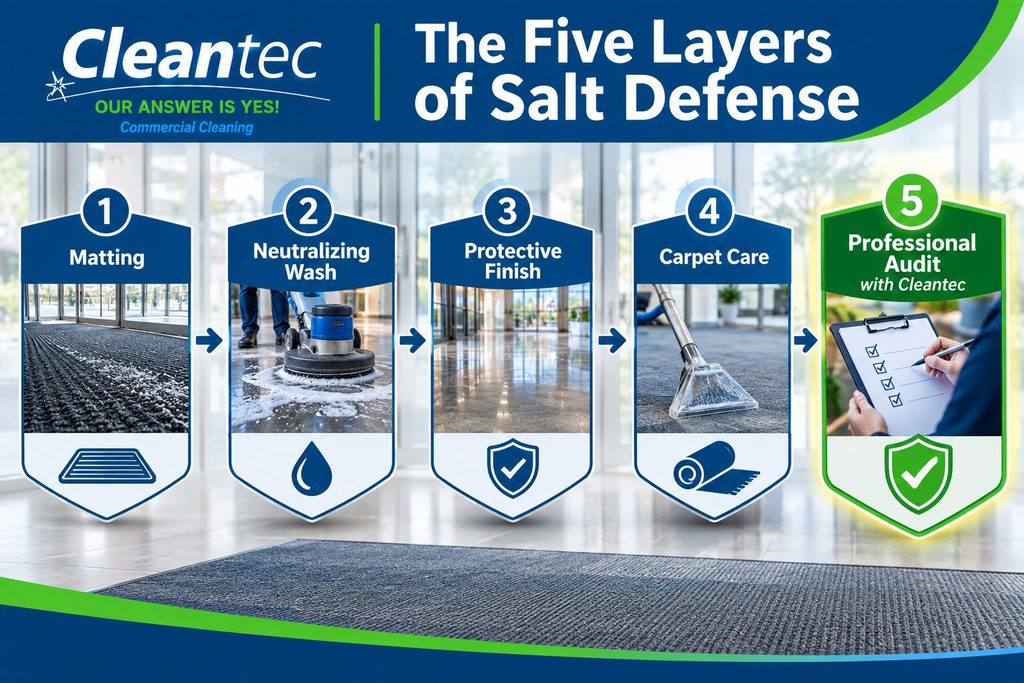
Note: To protect VCT tile from rock salt, stop salt at the door with at least 15 feet of matting, wash entry floors with a salt neutralizer instead of a standard neutral cleaner, keep a healthy layer of finish on the tile, and schedule professional scrub-and-coat work before damage reaches the tile itself. Steady commercial floor maintenance costs far less than a mid-winter strip and refinish.
The Hidden Cost of Upstate NY Winters on Commercial Flooring
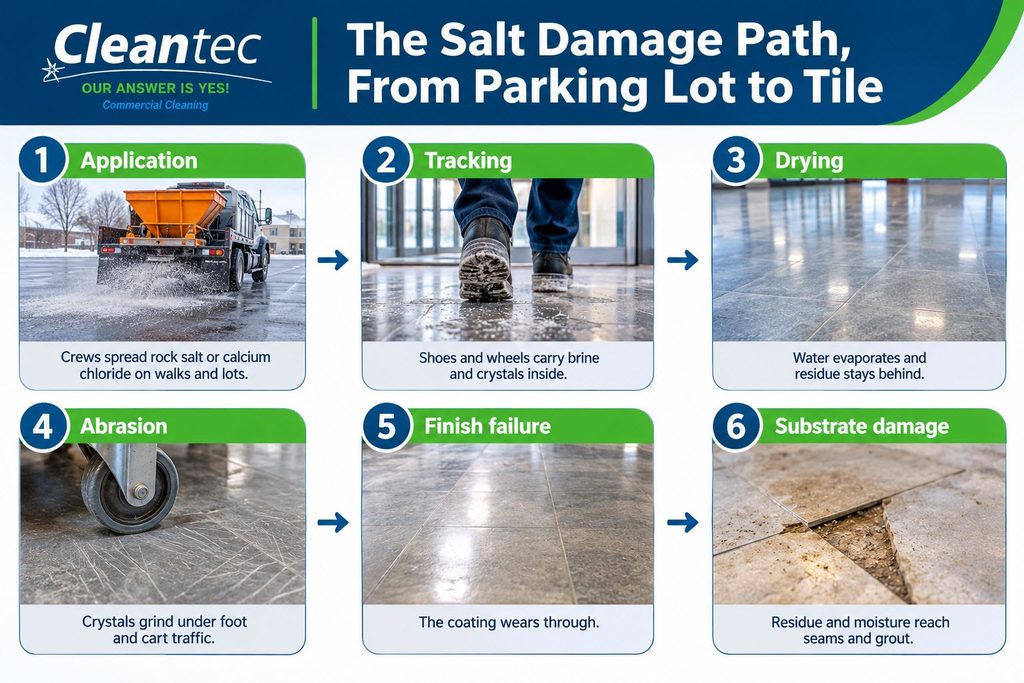
Ice melt looks harmless as a pile of white pellets, but it behaves differently once it reaches your floor. Rock salt is sodium chloride. Many properties also use calcium chloride blends because they keep working at very low temperatures (one floor care supplier notes calcium chloride melts ice down to about minus 25°F, per Kaivac). Shoes and cart wheels carry these products inside as brine and loose crystals. Trade reporting in Cleaning & Maintenance Management describes salt and slush traveling more than 150 feet into a building.
When winter brine dries, it leaves behind a film that many people mistake for dust. However, this residue is alkaline, not ordinary dirt. Floor care manufacturers explain that a standard mop and neutral cleaner may simply spread the salt residue around, leaving a white haze behind (Imperial Dade).
On coated floors, this buildup gradually dulls the gloss and wears down the protective finish as foot traffic grinds it into the surface. If the residue remains through several storm cycles, the damage can become more severe. According to a restoration contractor, the finish may eventually deteriorate to the point where stripping and recoating the floor is the only solution (ServiceMaster).
Salt also does a second kind of damage that has nothing to do with chemistry. Calcium chloride has a rough texture, and loose granules under shoes, carts, and floor machines work like fine sandpaper. They scratch finish on VCT, cut carpet fibers, and splinter wood floors, and left too long they can cause dry rot in carpet (Betco). When moisture and ice melt work into grout lines or seams, they can reach the adhesive underneath and weaken the bond holding tile in place (CleanLink).
Here is what that means in practice. A floor that loses finish at the entrance gets scratched at the tile surface, and bare VCT is much harder to clean and restore than a coated one. We see this most in school vestibules, medical lobbies, and retail entrances, where thousands of shoes grind salt into the same few square feet every day. Protecting the finish costs less than rebuilding it, which is the whole case for planned commercial floor maintenance in Upstate NY.
Building an Effective Winter Entrance Matting System
Matting returns more than any chemical you buy later, because it keeps salt off the floor in the first place. The industry shorthand is the 15-foot rule. You want at least 15 feet of matting from the door inward so each foot lands on the mat about three times before reaching the floor (CleanLink). It is recommended to divide into five feet each of scraper, wiper-scraper, and wiper matting (CleanLink). A winter-focused distributor goes further and suggests roughly 15 feet outside plus another 15 feet inside for buildings with hard floors (Imperial Dade).
Each mat has a different job. Scraper mats sit outside and knock off ice, grit, and salt chunks. Wiper-scraper mats continue the work and start absorbing moisture. Wiper mats finish drying the sole so the shoe reaches your floor clean. The most common mistake we see is a single small mat at the door. It looks like a system, but it only handles a sliver of the foot traffic.
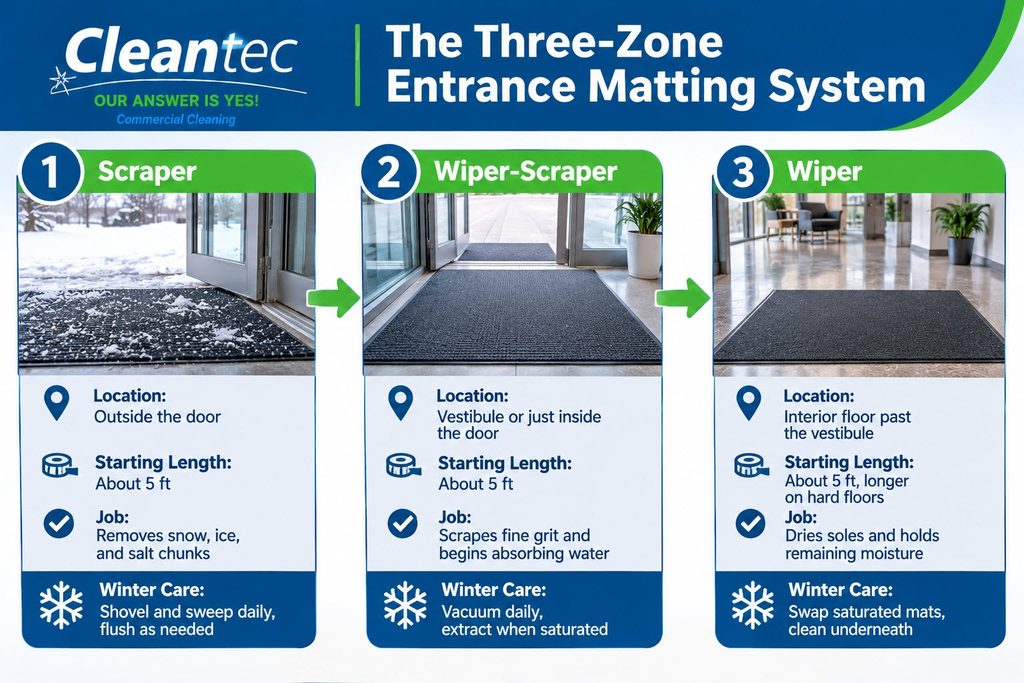
Treat those lengths as a minimum. In heavy Upstate snow, we usually recommend extending the wiper zone on hard-floor lobbies and at every hard-to-soft transition, such as where tile meets carpet.
Floor mats can only trap dirt and moisture when they have enough capacity. Once a mat becomes saturated, it can start transferring soil and moisture back onto the floor. A Carpet and Rug Institute standards director explains in Cleaning & Maintenance Management that wiping your feet on a dirty mat simply transfers more soil and moisture to the carpet.
During winter storms, follow these steps to keep entry mats effective:
- Vacuum mats daily to remove loose dirt, grit, and salt before they spread through the building.
- Check for moisture buildup throughout the day. If a mat feels wet or looks saturated, remove it and extract the moisture using appropriate carpet-cleaning equipment.
- Rotate or replace saturated mats with clean, dry sections so entrances always have effective coverage.
- Lift mats daily and vacuum or clean the floor underneath. Salt and moisture often collect beneath the edges.
- Remove mats before washing the surrounding floor. Clean and dry the floor beneath them before putting the mats back. This prevents water from seeping underneath and becoming trapped (Imperial Dade).
Cleantec’s janitorial crews can fold mat care into a nightly route, and our team can walk your entrances and tell you where the matting runs short. Details on that service are on our janitorial services page.
Daily Neutralization Washing Protocols
Standard neutral floor cleaners fail against salt for a simple reason. They are built to lift ordinary soil at a pH near 7. Salt residue is alkaline and mineral based, so it needs a product that chemically counters it. Floor neutralizers are formulated slightly acidic, and one manufacturer data sheet lists a pH between 3 and 5 (Nyco product sheet). That lets the product dissolve ice melt film and clear the haze while it cleans. A neutralizer is not the same thing as a neutral cleaner, even though the names sound alike, and mixing them up explains many of the hazy floors we are called to fix.
On hard floors during storm weeks, our crews follow a routine like this:
- Put on gloves and eye protection, read the label, and mix at the stated dilution. Test a small area first.
- Lift the mats and dust-mop or sweep loose grit and salt before any water touches the floor.
- Apply the neutralizer to entrances, vestibules, elevator lobbies, and main corridors.
- Scrub with an auto scrubber or mop, respect the dwell time on the label, then pick up the solution with a squeegee or wet vacuum.
- Rinse where the product calls for it and let the floor dry before the mats go back down.
- Change solution often and flush scrubber tanks and lines afterward, since salt residue can clog equipment (Imperial Dade).
Mistake to avoid: Running one mop bucket all day. Dirty solution puts dissolved salt right back on the floor, and the haze returns before the floor dries.
Frequency depends on traffic and weather. One supplier recommends neutralizing high-traffic entries about every two hours during active storms. Few in-house teams can staff that, which is where an evening neutralizing pass or an outside crew earns its fee. Our hard surface floor cleaning teams run this process with auto scrubbers, and we adjust the schedule to your door counts rather than the calendar.
One caution: Do not reach for a harsh acid or a strong alkaline product as a shortcut. A cleaner with extreme pH can strip the finish you are trying to protect, so stay with a product made for ice melt residue and follow its label.
VCT Scrub-and-Coat vs. Full Strip-and-Wax Schedules
Finish is a sacrificial layer. It exists so salt and grit hit the coating instead of the tile. When we talk about commercial floor maintenance for VCT, we really mean managing that layer: its thickness, its gloss, and the moment you refresh it. A scrub and recoat adds another layer of finish and lowers the risk of tile damage (Imperial Dade).
Start before the first storm. A scrub and recoat in October or early November builds extra protection where traffic is heaviest. Waiting is a bad trade, because contaminants tracked in before a strip can interfere with the new finish and hurt the results.
Mid-winter is when top scrubbing proves its value. We use a floor machine or auto scrubber with the right pad and a neutralizing solution to remove the dirty, hazed surface layer of finish without taking the floor down to bare tile. Then we apply fresh coats, commonly two to three depending on the finish manufacturer, and let them cure before heavy traffic returns. Done in February, this rebuilds the barrier salt has been thinning since December.
Scrub-and-Coat vs. Strip-and-Wax for Salt-Exposed VCT
| Factor | Scrub-and-Ccoat (Top Scrub) | Full Strip-and-Wax |
| Purpose | Refresh the worn top layer and add finish | Remove all finish and rebuild from bare tile |
| Best timing | October prep and mid-winter in entry zones | Spring, after salt season ends |
| Condition of floor | Finish is still intact under the haze | Bare tile, deep scratches, or stained, failed finish |
| Downtime and labor | Shorter, easier to schedule after hours | Longer, with more chemical and cure time |
| Disruption | Low, can be done zone by zone | Higher, often needs section closures |
| Risk if skipped | Finish thins and salt reaches the tile | Scratched and stained tile that cleaning cannot fix |
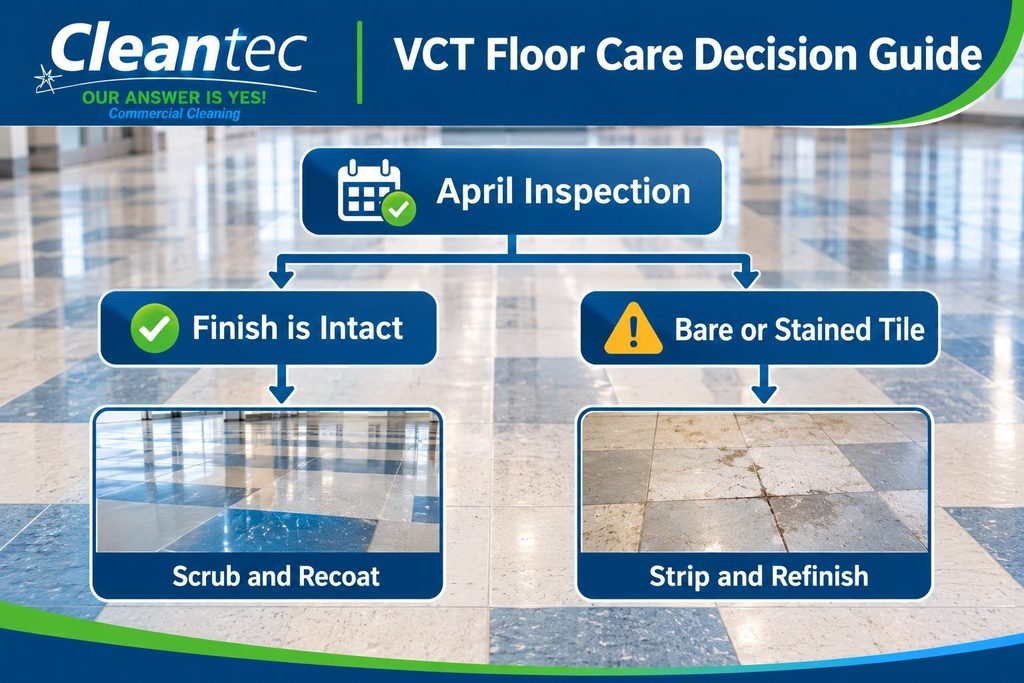
In April, inspect your entrances. If the finish is intact beneath the haze, another scrub and recoat may be enough. If you find bare tile, deep scratches, or stains, a strip and refinish is the honest answer. After stripping, neutralize the floor before sealing and finishing, because leftover alkaline residue hurts bonding (Nyco product sheet). Many clients ask us to treat entryways as their own zone. A lobby may need full restoration while interior hallways only need a recoat, and that split saves real money.
Commercial Carpet Winter Care & Salt Ring Removal
On carpet, salt shows up as a stiff, pale ring at the edge of mats and along walking lanes, usually where slush dried. It is more than cosmetic. Crystals cut fibers as people walk, and constant dampness plus salt can break down backing over time. Good winter carpet protection for an office starts with the same matting system, plus a vacuum schedule that doubles in January. Dry soil and salt come out easily before slush turns them into paste, so vacuum entry lanes daily and treat spots as they appear (Cleaning & Maintenance Management).
The main decision in winter is how to clean. Low-moisture encapsulation uses a polymer that bonds to soil so you can vacuum it away. It dries quickly, which matters when slow drying means damp carpet and more tracked-in slush. In our experience it works best for interim cleaning along traffic lanes. Hot-water extraction flushes and removes dissolved salt more completely, so it is the better choice when white crust is heavy or salt has soaked into the pile. The tradeoff is drying time. In cold buildings, use air movers and book extraction late in the week so the carpet is dry by Monday.
Some facilities need both. Encapsulation keeps entrance carpet presentable between storms, and a spring extraction resets the whole floor. Our commercial carpet cleaning team plans that mix around your occupancy and drying conditions.
Preventive Maintenance Checklist for Upstate NY Facility Managers
This is the calendar we hand to facility managers who want a clear plan. Adjust the timing to your first hard freeze and your last big storm.
Month-by-Month Winter Flooring Maintenance Timeline (November to April)
| Month | Hard Floors and VCT | Carpet | Professional Touchpoint |
| November | Inspect finish, scrub and recoat entry zones, install full matting, stock neutralizer | Vacuum deeply, pre-treat entry lanes | Pre-season floor assessment |
| December | Daily mat care, neutralize after each storm event | Daily vacuuming, spot removal | Check mat layout and neutralizing routine |
| January | Peak salt load, increase neutralizing in entrances and lobbies | Encapsulate worn traffic lanes | Top scrub in the worst zones |
| February | Top scrub and recoat entries, recheck mat condition | Interim encapsulation, address salt rings | Mid-winter recoat |
| March | Keep neutralizing through freeze-thaw swings, document wear | Extraction if white crust returns | Spring planning |
| April | Strip-and-refinish decision, neutralize before sealing | Hot-water extraction | Full restoration of entrances |

A calendar only helps if someone owns it. We suggest naming one person who checks mats daily and approves each neutralizing pass, with a short log of storm dates. That log tells you at the end of the season whether your commercial floor maintenance schedule matched the weather or fell behind it.
When Should Facilities Hire a Commercial Cleaning Professional?
Your own team can handle daily sweeping, mat swaps, and light neutralizing. Bring in professionals when any of these show up:
- You have not recoated entry zones by early winter, and traffic is already high.
- White haze returns within a day or two of neutralizing.
- Finish looks worn, gray, or scratched at entrances and along main corridors.
- Your team lacks auto scrubbers, floor machines, or carpet extractors.
- Hours are tight and floor work has to happen overnight or on weekends.
- April inspection shows bare tile or stained carpet.
The usual objection is cost, and it is a fair one. Compare it honestly, though. A planned scrub and recoat takes a night or two. A late-spring strip and refinish across a damaged lobby takes much longer, uses more chemical, and may close sections of the building. Cleantec brings trained crews, commercial equipment, and a documented schedule, and we hold the ISSA CIMS-GB with Honors certification. We are bonded and insured, and we have served Upstate NY facilities since 1975. If you operate in Syracuse, Albany, Buffalo, or Rochester, we can reach you. For larger buildings, our facility maintenance services bring floors, carpet, and daily janitorial work under one plan.
Protect the Floor Before Salt Does
Salt damage in Upstate NY is not a surprise. It arrives on a schedule, and it moves through the same steps every year, from tracked-in brine to white haze to worn finish. You stop it with layered defenses. Stop salt at the door with real matting, neutralize what gets through, keep a fresh layer of finish on VCT, and clean carpet before salt rings set. Facilities that treat commercial floor maintenance as a seasonal plan spend less on restoration and keep entrances looking professional through March.
Frequently Asked Questions
Can rock salt damage VCT tile?
Yes. Salt crystals scratch floor finish, and the alkaline residue leaves a white haze that dulls and wears the coating. If residue sits through repeated storms, the finish can fail, exposing the tile and forcing a strip and refinish.
How do you protect VCT tile from rock salt?
Install at least 15 feet of entrance matting, clean mats daily, wash entry floors with a salt neutralizer, and keep several coats of finish on the tile. Professional scrub-and-coat service in mid-winter restores the barrier before damage spreads.
What is the difference between a floor neutralizer and a neutral floor cleaner?
A neutral cleaner sits near pH 7 and lifts ordinary soil, but it cannot dissolve alkaline salt residue. A floor neutralizer is slightly acidic, so it breaks down ice melt film and clears the white haze in one pass.
How long should entrance matting be in winter?
Plan for at least 15 feet of matting at each entrance, using scraper, wiper-scraper, and wiper sections. Hard-floor lobbies in heavy snow regions often benefit from more, because each foot should touch the matting at least three times.
When should a facility hire a commercial cleaning company for winter floors?
Hire help before winter starts for a protective recoat, when white haze returns after neutralizing, when finish looks worn at entrances, or when your team lacks scrubbers and extractors. Spring restoration also warrants professional review.
What does professional commercial floor maintenance include during winter?
It typically covers mat service, scheduled neutralizing washes, auto scrubbing, top scrubbing with fresh coats of finish, carpet extraction or encapsulation, and a spring inspection that decides whether tile needs stripping and refinishing.
Schedule Your Seasonal Floor Defense Audit with Cleantec
Don’t wait for the white haze. Before the next storm, let Cleantec walk your entrances, check your matting, assess the finish on your VCT, and build a winter plan that fits your traffic and budget. Our commercial floor maintenance programs have protected Upstate NY facilities since 1975, and we would like to protect yours.
Contact Cleantec today to schedule a site walk-through and receive a clear, no-obligation janitorial proposal tailored precisely to needs.
- Direct Phone: 1 (877) 469-0543
- Direct Email: info@cleantec.us
- Request an Online Quote: https://www.cleantec.us/request-a-quote/
- Corporate Address: 1232 Tulip Street, Liverpool, NY 13090
Older Post
- Technicians Offered IICRC Classes at Cleantec
- Success Starts with a Clean Workplace
- Home Maintenance Tips for Mid-Winter
- How to Remove Tough Carpet Stains
- 7 Tips to Help Sell Your House
- Ensure Your Fire Alarm Works Properly
- Cleaning Tips to Help You Live Green
- Window Cleaning Tips from the Professionals
- Safe Proof Your Home to Prevent Storm Damage
- Cleantec Marks Two-Year Partnership with Cleaning for a Reason