
Everything You Need to Know About Commercial Carpet Cleaning
December 31, 2025For most building owners and facility managers, carpeting represents a significant portion of the initial budget, yet it is often the most neglected asset regarding long-term cleaning strategies. We tend to view carpet as a static aesthetic choice.
However, the reality of commercial facility management is far more complex. Your carpet is not just a floor covering; it is a building-wide air filter, a sound dampener, and a primary indicator of tenant value. When neglected, it becomes a liability that degrades indoor air quality, increases energy costs, and necessitates premature capital expenditures.
This guide explores the financial logic, the complex chemistry of textiles, and the hidden dangers lurking in your carpet fibers, providing the insights you need to protect your investment.
The Economics of Extraction: Why Cleanliness Equals Capital Retention
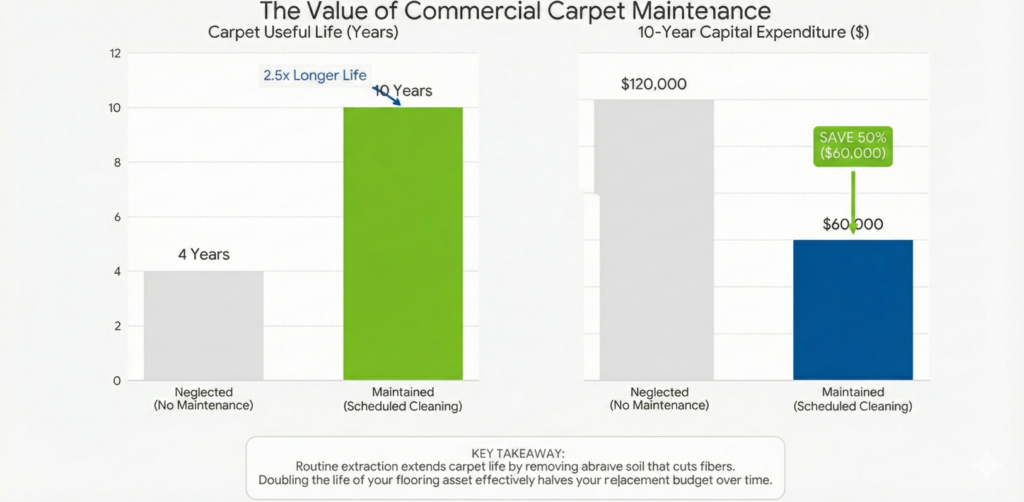
The difference between a “clean-looking” carpet and a chemically clean carpet is often measured in tens of thousands of dollars. According to the Carpet and Rug Institute, commercial carpet is engineered to have a useful life of 7 to 12 years. However, without a scheduled preventative maintenance program, that lifespan typically plummets to just 3 to 5 years.
Consider the financial mechanics of replacement versus maintenance:
- The Replacement Reality: Replacing 10,000 square feet of commercial broadloom or carpet tiles is a massive undertaking. Between materials, labor, furniture lifting, and disposal fees, costs can range between $40,000 and $80,000.
- The Disruption Cost: Beyond the invoice, there is the operational cost. Replacing flooring shuts down revenue-generating spaces, disrupts employee productivity, and creates logistical challenges.
- The Maintenance Arbitrage: A consistent, restorative maintenance program costs a mere fraction of replacement. By extending the life of the carpet from 4 years to 10 years, you effectively halve your capital expenditure over a decade. The ROI of cleaning is not found in the cleaning bill itself, but in the deferred cost of the new floor.
Most carpet warranties require proof of professional hot-water extraction every 12 to 18 months. Failing to provide these records can void your warranty, leaving you with zero recourse if the product fails prematurely.
The Cleaning Challenges Associated with Common Types of Carpet Fabric
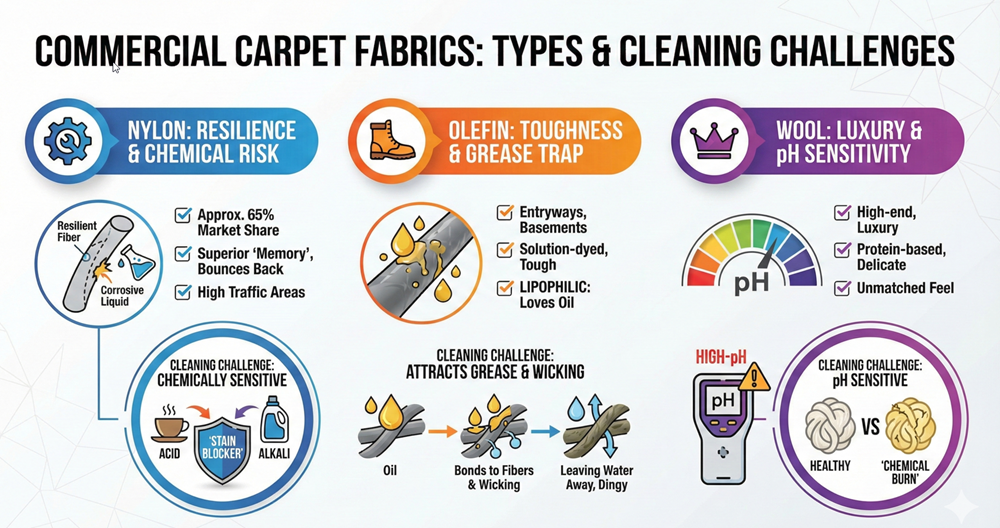
One of the biggest mistakes building owners make is assuming all “rugs” are the same. Commercial textiles are complex polymers, and treating them incorrectly can ruin the material.
Here is a breakdown of the three most common commercial fibers and the unique challenges they present.
Nylon
Nylon makes up approximately 65% of the commercial market. It is prized for its “memory” – the ability of the fiber to bounce back after being compressed by foot traffic or furniture.
- The Nylon Cleaning Challenge: While physically tough, nylon is chemically sensitive. It is highly susceptible to staining from acid dyes (found in coffee, wine, and fruit juices). If an untrained cleaner uses a high-alkaline chemical and fails to neutralize it, they can strip the factory-applied stain blocker. Once that protection is gone, the nylon becomes a sponge for permanent discoloration.
Olefin (Polypropylene)
Often found in entryways, basements, and lower-budget installations, Olefin is solution-dyed, making it nearly impossible to bleach out color. However, it has a fatal flaw: it is lipophilic, meaning it loves oil.
- The Polypropylene Cleaning Challenge: Olefin fibers attract grease from parking lots, asphalt, and shoe rubber. This oil bonds to the fiber at a molecular level. If a cleaner uses standard water-based detergents without a heavy-duty degreaser and high heat, the carpet will remain dingy and gray even after scrubbing. This is known as “wicking,” where the oil effectively rejects the water and keeps the dirt.
Wool and Natural Blends
Found in high-end law firms, boardrooms, and luxury hotels, wool offers a look and feel that synthetics cannot match.
- The Wool Blend Cleaning Challenge: Wool is protein-based, much like human hair. It is incredibly sensitive to pH. Standard commercial cleaning agents are often high-pH (alkaline) to cut through grease. If these are used on wool, it causes “chemical burn,” turning the fibers yellow, brittle, and eventually causing them to dissolve. Wool requires specific, neutral-pH agents and low-moisture handling.
The Hidden Dangers Beneath the Carpet Surface
If your strategy is to clean the carpet only when it “looks dirty,” you may have already waited too long. Carpet fabric hides soil. A square yard of commercial carpet can hold one pound of dirt before it appears visibly soiled to the naked eye.
But visible dirt isn’t the real enemy. Here are the hidden issues impacting your facility:
The “Filter” Saturation
Carpet traps airborne pollutants, pollen, and dust mites. This is good for air quality until the carpet becomes full. Once saturated, foot traffic acts as a bellows, pumping those allergens back into the breathing zone. This leads to increased asthma complaints, and higher absenteeism.
The VOC Cycle
Volatile Organic Compounds from paints, glues, and plastics settle into the floor. Without thermal extraction (heat), these chemicals are never removed. When the building heats up in the winter, the carpet off-gasses these trapped chemicals, creating a stale, unhealthy atmosphere.
Filtration Soiling
Have you ever noticed dark black lines around the edges of a room or under closed doors? This is filtration soiling. It occurs when air is forced through the gap between the carpet and the wall, depositing microscopic pollutants deep into the fibers. This soil is electrostatically bonded and is notoriously difficult to remove without specialized agitation tools.
Why In-House Janitorial Carpet Cleaning Often Fails
Many building owners attempt to save money by having their nightly janitorial staff “shampoo” the carpets. While the initial intention is clear, the execution often damages valuable carpeting.
Janitorial crews typically use portable extractors or bonnet machines. These machines lack the heat and suction necessary for true restoration and pristine carpet cleaning.
- Lack of Heat: To break the bond of oily soils, water needs to be upwards of 180°F – 200°F. Portable machines rarely maintain this temperature.
- Lack of Removal: Without a truck-mounted vacuum system, portable machines leave a significant amount of water and chemical residue in the carpet.
- The Resoiling Loop: The soap residue left behind dries into a sticky film. This film attracts new dirt immediately. This is why carpets cleaned by amateurs often look dirty again within two weeks. It creates a cycle where you are cleaning more often with diminishing returns.
Cleantec is Your Upstate NY Carpet Cleaning Leader
For building owners in Syracuse, Ithaca, Albany, Buffalo, and throughout Upstate New York, Cleantec has established itself as the regional leader in commercial carpet maintenance and facility cleaning services.
Since 1975, Cleantec has combined ISSA CIMS-GB certified processes with cutting-edge high-performance carpet cleaning technology. Our cleaners harness industrial truck-mounted extraction units that deliver the high heat and lift required to remove impacted soil, salt, and winter grime unique to the New York climate.
Whether you manage a high-traffic university, a sterile medical facility, or a corporate headquarters, Cleantec’s team understands the specific chemistry required to extend the life of your carpets.
Don’t let your investment deteriorate. Contact Cleantec today to schedule a free consultation and develop a maintenance plan that protects your facility’s flooring and your bottom line.
Answers to Common Commercial Carpet Cleaning Questions
How often should we professionally clean our commercial carpets?
Frequency is dictated by foot traffic. High-traffic zones (entrances, elevators, main corridors) require cleaning every 3 to 6 months. Moderate areas (conference rooms, cubicles) can be serviced every 6 to 12 months. Executive offices with low traffic may only need cleaning every 12 to 18 months.
Is “Steam Cleaning” better than “Dry Cleaning”?
They serve different purposes. “Steam cleaning” (Hot Water Extraction) is the only method that deeply removes soil and allergens. This is required for restoration. “Dry cleaning” (Encapsulation) is a low-moisture maintenance method excellent for improving appearance in between deep cleanings. The best maintenance program uses a hybrid of both.
Will cleaning the carpet wet the subfloor or cause mold?
Not when performed by professionals. Problems with mold and delamination (where the backing separates) occur when inexperienced cleaners use too much water and have too little vacuum power. A professional truck-mounted system recovers 95% of the moisture, allowing carpets to dry in 4 to 6 hours.
Can you remove coffee stains that have been there for months?
Often, yes. However, success depends on whether the stain was previously treated with consumer-grade products. If an employee poured a store-bought cleaner on it, they may have chemically “set” the stain. Professional heat-transfer methods have a very high success rate, but immediate professional attention is always best.
What is “Wicking” and why do stains come back?
Wicking happens when the carpet fiber dries from the top down. If deep cleaning wasn’t thorough, moisture at the base of the carpet wicks up the fiber as it dries, carrying dissolved dirt with it. This results in a stain reappearing days after cleaning. This is a hallmark of insufficient vacuum power or improper technique.
Older Post
- Technicians Offered IICRC Classes at Cleantec
- Success Starts with a Clean Workplace
- Home Maintenance Tips for Mid-Winter
- How to Remove Tough Carpet Stains
- 7 Tips to Help Sell Your House
- Ensure Your Fire Alarm Works Properly
- Cleaning Tips to Help You Live Green
- Window Cleaning Tips from the Professionals
- Safe Proof Your Home to Prevent Storm Damage
- Cleantec Marks Two-Year Partnership with Cleaning for a Reason