
Day Porters vs. Nighttime Cleaning Crews: Evaluating the Right Janitorial Model for Your Building
September 17, 2026Facility managers across Upstate New York must balance tenant health, safety compliance, and tight operating budgets. Properties in Syracuse, Albany, Buffalo, Rochester, Ithaca, and Binghamton face distinct operational demands that simple cleaning routines cannot solve. Deciding between a day porter and a nighttime cleaning crew represents a major operational choice for any commercial building manager.
Selecting an improper janitorial schedule often leads to visible building wear, higher slip-and-fall liabilities, and inconsistent cleaning quality. Relying exclusively on overnight crews leaves daytime spills, dirty entryways, and unstocked restrooms unaddressed for hours. Conversely, deploying staff only during business hours prevents teams from using heavy floor scrubbers, hot-water carpet extractors, or high-decibel vacuums that disrupt daily office work.
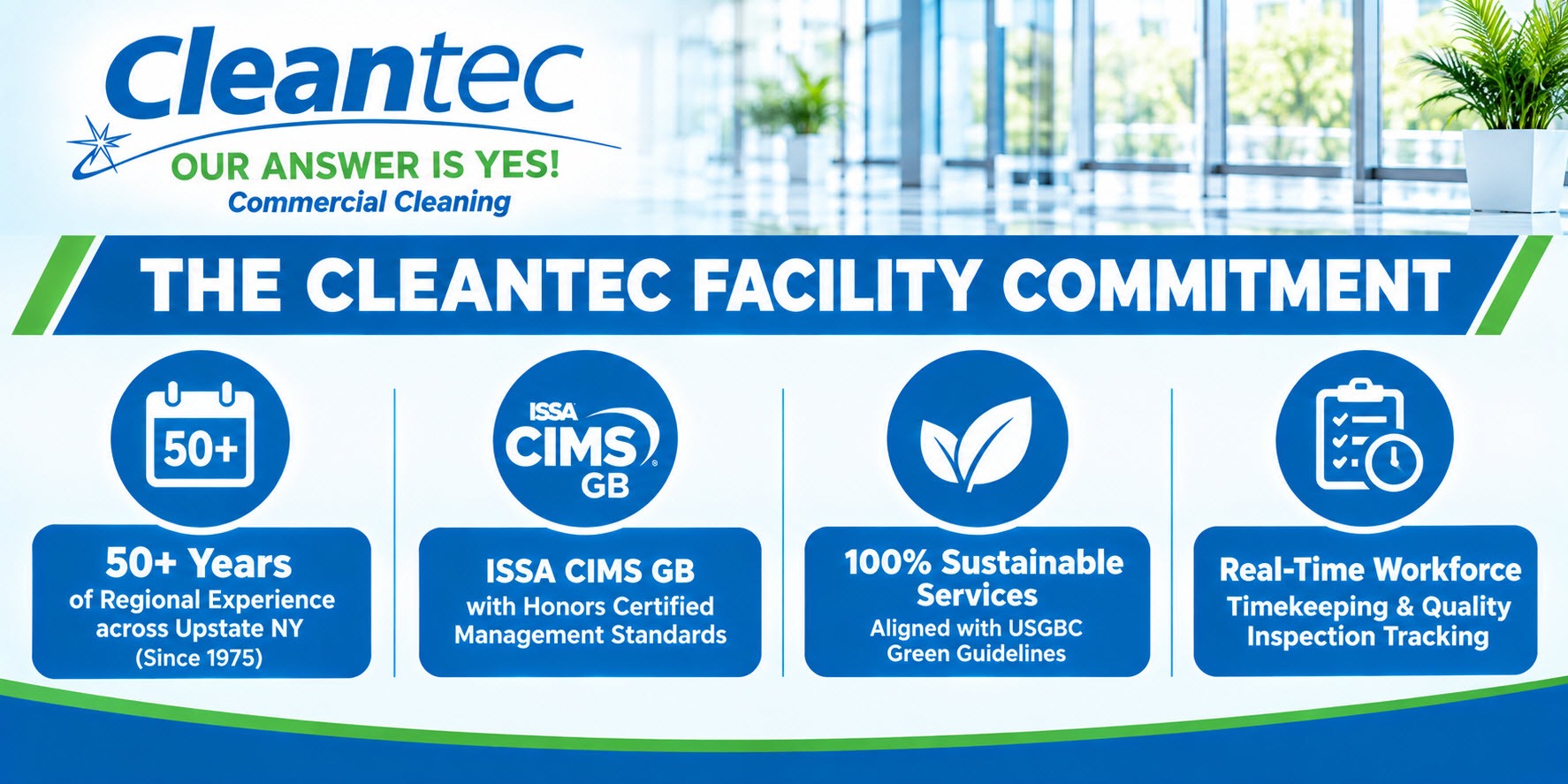
Cleantec has delivered customized commercial cleaning programs across New York State since 1975. Holding the ISSA CIMS GB with Honors certification, Cleantec builds janitorial schedules aligned with United States Green Building Council (USGBC) standards. In this guide, we will evaluate the practical mechanics, financial considerations, and regional weather factors required to choose the right janitorial cleaning services model for your facility.
Defining the Models: Core Capabilities and Scope
What is a Day Porter?
A day porter operates as an on-site, dedicated facility steward working directly alongside your staff and visitors during normal business hours. Rather than moving systematically through an empty property, a day porter focuses on high-visibility maintenance, high-touch sanitization, and rapid hazard response.
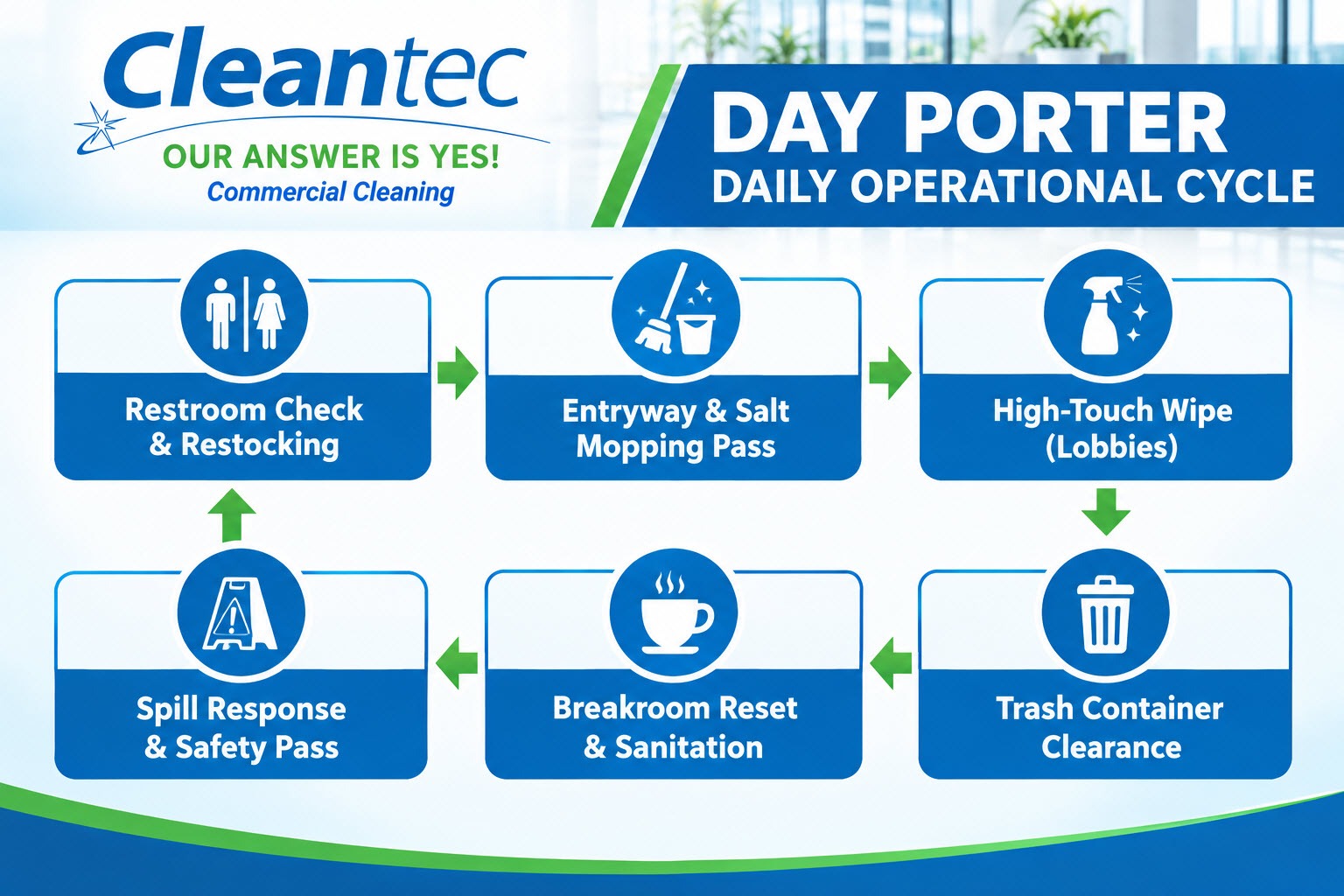
Primary Duties of a Day Porter
- Restroom Maintenance: Monitoring paper supply levels, replenishing soap dispensers, wiping counters, and managing odor control throughout peak usage hours.
- Entryway and Floor Safety: Mopping tracked-in water, clearing winter salt residue, cleaning glass doors, and setting out safety cones.
- High-Touch Disinfection: Wiping down elevator buttons, stair handrails, door handles, and lobby reception counters.
- Breakroom Upkeep: Sanitizing counters, cleaning tables, wiping appliance exterior surfaces, and clearing overflowing trash bins.
- Immediate Spill Response: Containing liquid, chemical, or food spills quickly to comply with workplace safety guidelines and prevent injuries.
What is a Nighttime Cleaning Crew?
A nighttime janitorial crew operates after business hours when occupants have left the building. Working in an empty facility allows technicians to operate heavy machinery without creating noise distractions or safety hazards for your staff.
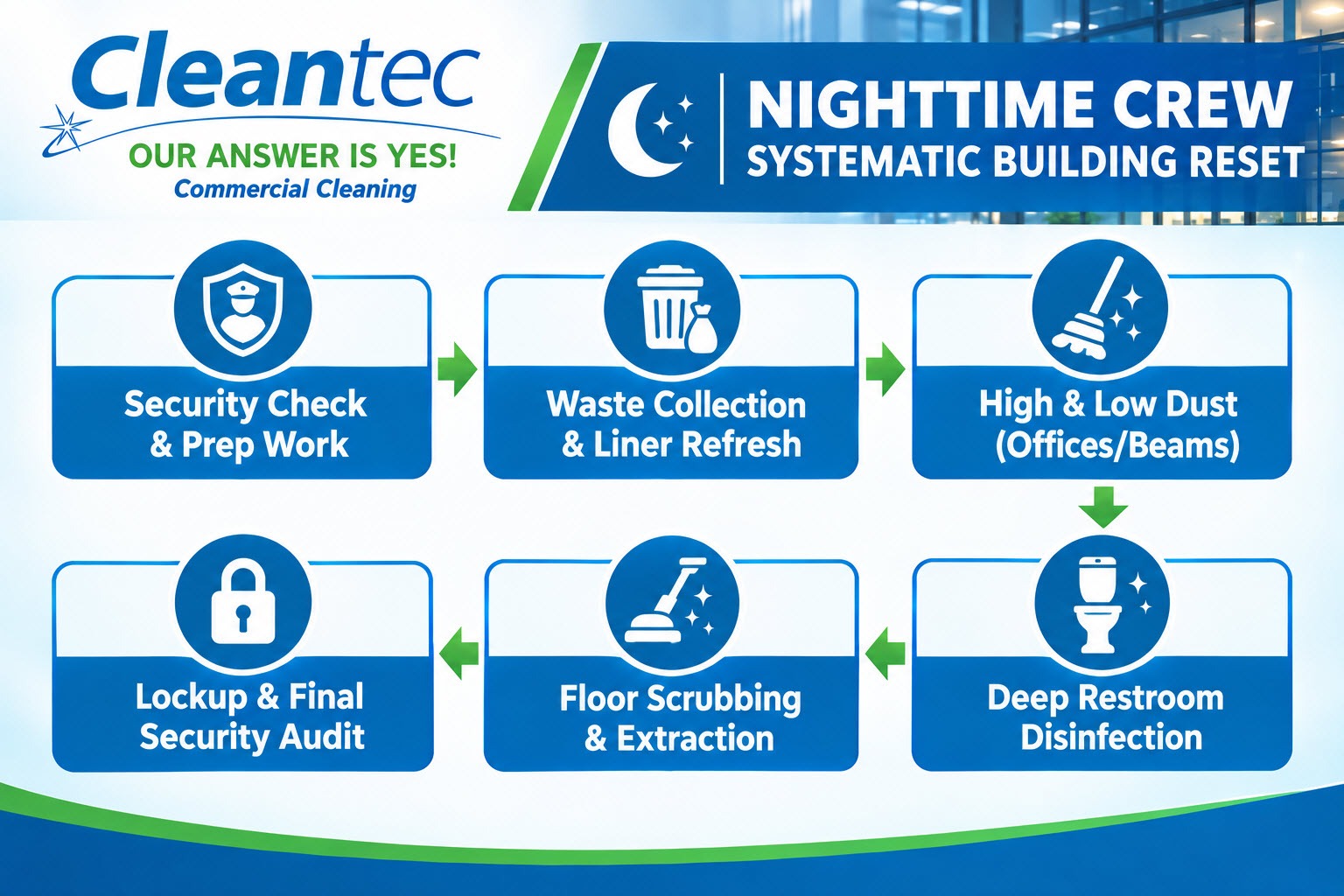
Primary Duties of a Nighttime Cleaning Crew
- Detailed Floor Care: Running automated floor scrubbers over hard surfaces, vacuuming carpets across all office suites, and burnishing tile floors.
- Deep Restroom Sanitization: Washing wall tiles, scrubbing fixtures, disinfecting partitions, and clearing floor drains.
- Comprehensive Waste Disposal: Emptying every personal desk trash bin, replacing plastic liners, and hauling waste to exterior dumpsters.
- Dusting Protocols: Microfiber dusting of desks, horizontal ledges, window sills, and overhead fixtures.
- Building Reset: Arranging lobby furniture, resetting conference rooms, and securing exterior doors before setting building alarms.
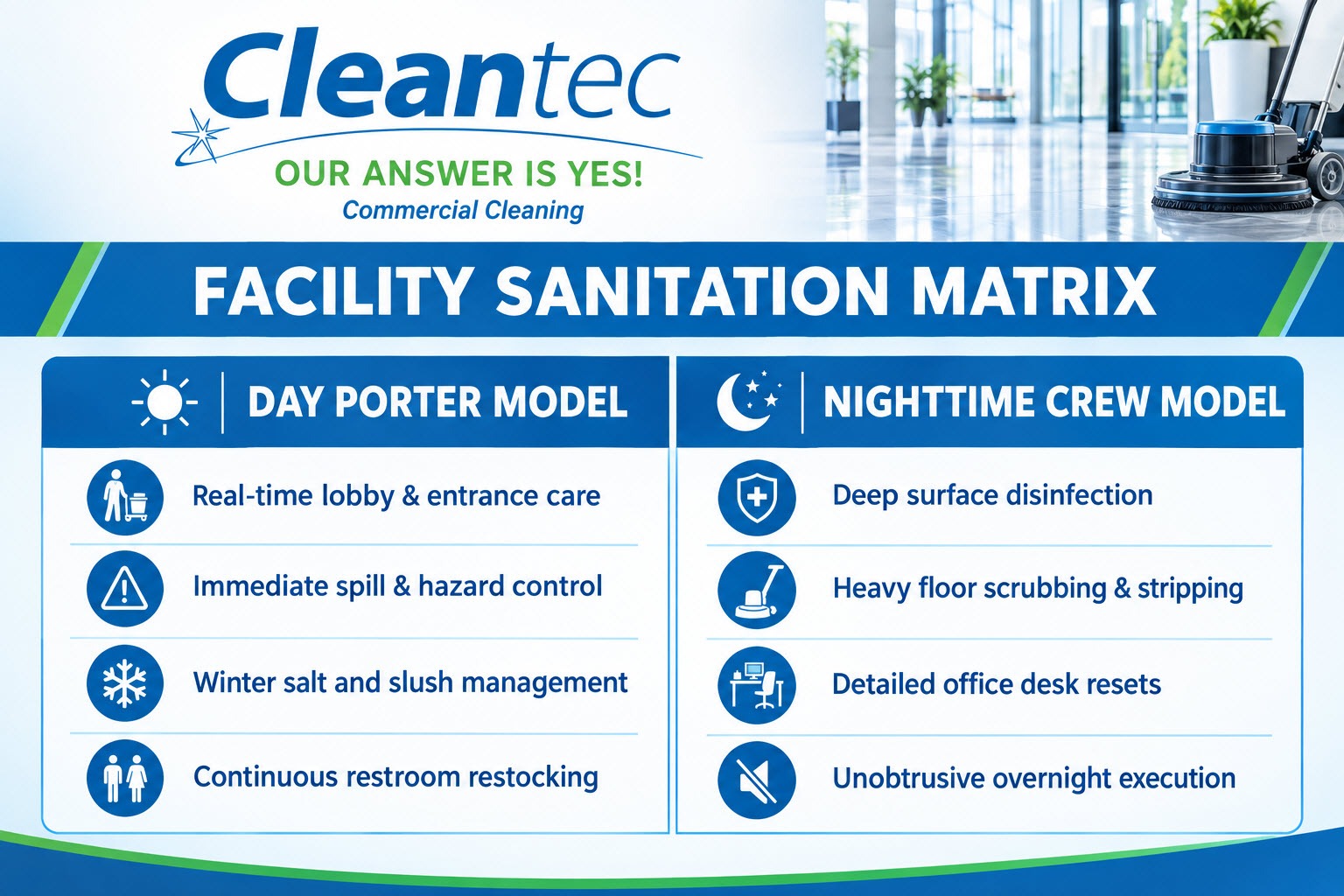
The primary distinction between day porters vs. nighttime cleaning comes down to operational timing and service focus. A day porter works on-site during active business hours to provide continuous upkeep, immediate spill response, entryway maintenance, and restroom restocking in high-traffic spaces. In contrast, an overnight janitorial crew works after hours when the facility is empty, executing deep surface disinfection, heavy machinery floor scrubbing, detailed vacuuming, and complete building resets.
Side-by-Side Operational Comparison
Evaluating the practical differences between day porters and nighttime cleaning crews helps clarify which structure matches your property’s daily routine.
Operational Comparison Matrix
| Operational Dimension | Day Porter Service | Nighttime Cleaning Crew | Hybrid Service Program |
| Primary Work Schedule | Active business hours (7:00 AM to 5:00 PM) | After-hours / Overnight (5:00 PM to 2:00 AM) | Continuous coverage split across day and night |
| Occupant Interaction | High direct contact with employees and visitors | Minimal contact inside an empty building | Day interaction paired with unobtrusive night work |
| Noise Profile | Quiet tools (microfiber cloths, quiet mops) | Heavy equipment (auto scrubbers, vacuums) | Low noise during day; heavy machinery at night |
| Response Capability | Immediate on-site response to daytime incidents | Delayed until the scheduled evening shift | Real-time daytime response plus nightly deep resets |
| Equipment Use | Mop carts, microfiber cloths, trash hampers | Ride-on scrubbers, hot-water extractors | Complete selection of commercial machinery |
| Primary Focus Areas | Lobbies, entrances, restrooms, breakrooms | Office desks, private suites, main hallways | Full facility envelope maintenance |
| Weather Management | Real-time salt, slush, and water cleanup | Overnight floor drying and salt neutralization | Total weather protection cycle |
| Financial Structure | Fixed hourly or single-staff rate model | Square-footage production rate model | Scaled contract based on labor allocation |
Facility Flow and Coverage Lifecycle
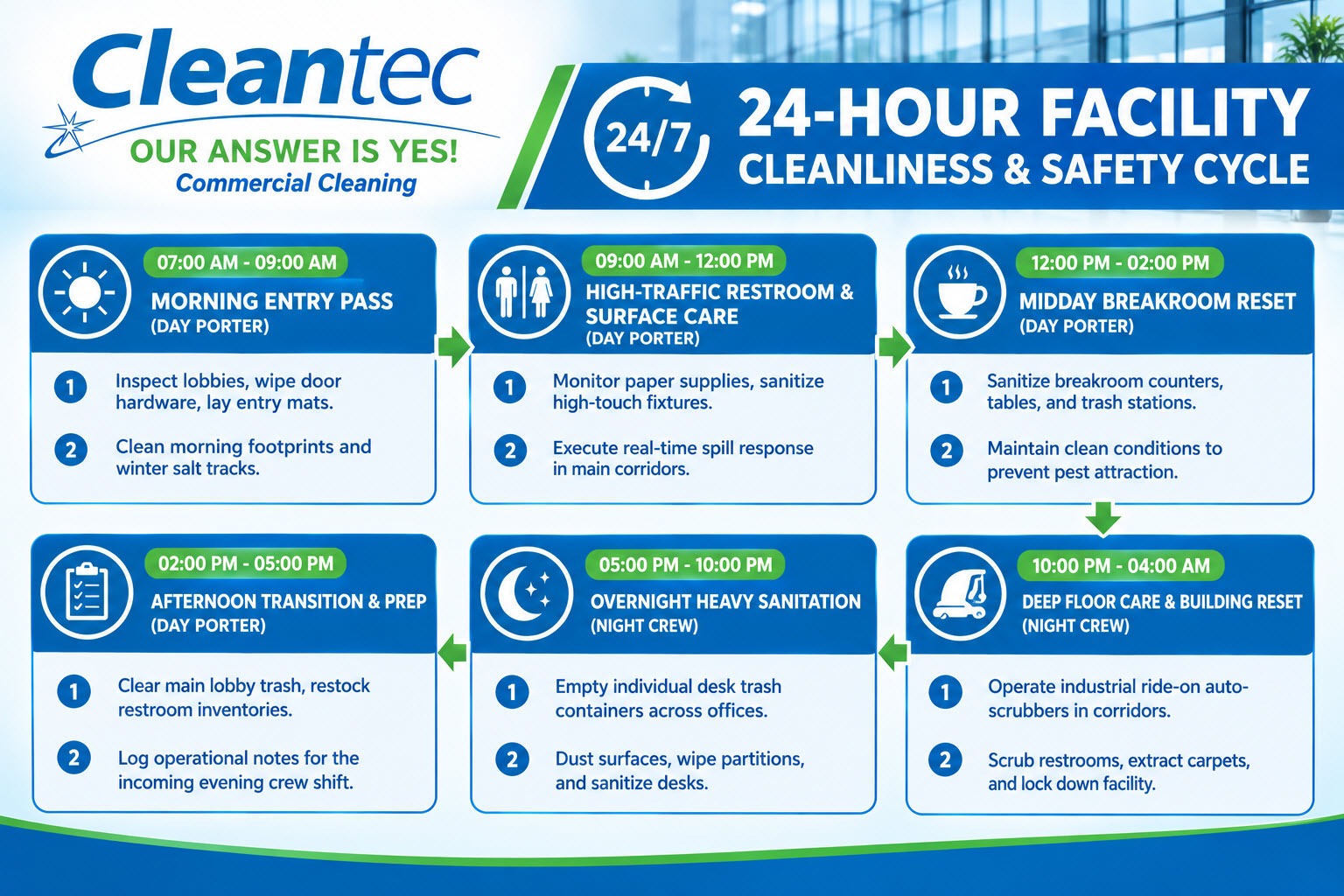
To visualize how these two roles coordinate across a full 24-hour workday, consider how tasks can be handed off between shifts. Day porters manage real-time foot traffic, immediate spills, and restroom restocking during active operating hours. Once business hours conclude, the nighttime janitorial crew executes deep floor care, detailed surface disinfection, and complete building resets. The sample schedule below shows how a coordinated cleaning model maintains safety and presentation throughout the entire operational day.
Sector-Specific Operational Analysis
Janitorial requirements vary significantly across different commercial sectors. Choosing between day porters and nighttime crews requires assessing the operational details of your specific industry.
Healthcare & Medical Outpatient Facilities
Medical facilities demand strict sanitation to prevent healthcare-associated infections.
Operational Example: Ambulatory Surgical Center in Syracuse
- Challenge: A 35,000-square-foot medical facility handles 250 patients daily. Waiting room chairs, door handles, and restrooms accumulate viral load rapidly during flu season.
- Solution: A hybrid janitorial model. The day porter sanitizes waiting room seating, restocks restrooms, and cleans check-in counters using EPA-registered disinfectants. The night crew executes terminal-style cleaning in exam rooms, scrubs floor tiles, and operates HEPA-filtration vacuums.
- Outcome: Lower cross-contamination risk, full compliance with CDC and OSHA guidelines, and improved patient confidence.
Relying solely on evening crews in medical environments presents real risks. Patient waiting areas accumulate germs by mid-morning. A day porter continuously sanitizing high-touch surfaces interrupts germ transmission during active hours.
Higher Education & Campus Housing
College dormitories and administrative buildings face heavy foot traffic and rapid turnarounds.
Operational Example: University Residence Hall in Ithaca
- Challenge: Managing multi-story student housing during active academic terms and handling rapid room turnarounds during move-in windows.
- Solution: Dedicated day porter support paired with term turnarounds. The day porter cleans communal restrooms twice daily, manages laundry room trash, and mops entrance mud. The night crew handles carpet extraction, floor stripping, and deep room resets during winter and summer breaks.
- Outcome: Reduced student complaints, better pest control, and on-time residence hall openings.
Dormitories experience rapid sanitation decline when left unmonitored during the day. Trash containers overflow, communal showers accumulate moisture, and lobbies collect outside mud. Day porters keep student housing stable throughout peak daytime activity.
Industrial Plants & Logistics Hubs
Industrial properties require heavy dust control, machinery care, and safety compliance.
Operational Example: Distribution Center in Buffalo
- Challenge: A 150,000-square-foot facility experiences constant forklift traffic, loading dock dirt infiltration, and heavy concrete dust accumulation.
- Solution: Industrial machinery cleaning scheduled at night, supported by daytime spill management. The day porter clears hydraulic fluid spills, sanitizes breakrooms, and keeps dock areas clear. The night crew runs ride-on scrubbers down main aisles and uses HEPA vacuums on overhead racking systems.
- Outcome: Research demonstrates that standardizing workplace cleaning cuts lost workdays by nearly half through accident reduction.
In logistics facilities, concrete dust acts as an abrasive agent that damages equipment and lowers indoor air quality. Combining daytime spill response with nighttime machine scrubbing keeps floors safe and protects inventory investments.
Corporate Offices & Financial Institutions
Corporate offices and banks rely on pristine presentation to support their professional image.
Operational Example: Regional Financial Office in Albany
- Challenge: Maintaining spotless entrance glass, polished lobbies, and secure office suites for financial clients.
- Solution: Discreet day porter support paired with secure night cleaning. The day porter wipes entrance glass, maintains executive restrooms, and clears coffee stations. The night crew vacuums office suites, empties trash, and cleans client meeting rooms under strict security protocols.
- Outcome: High visual standards paired with data security compliance.
Financial facilities require bonded, background-checked cleaning personnel. Day porters maintain a neat appearance in public areas, while night crews follow security guidelines to clean private offices and administrative zones.
Upstate New York Climate Considerations
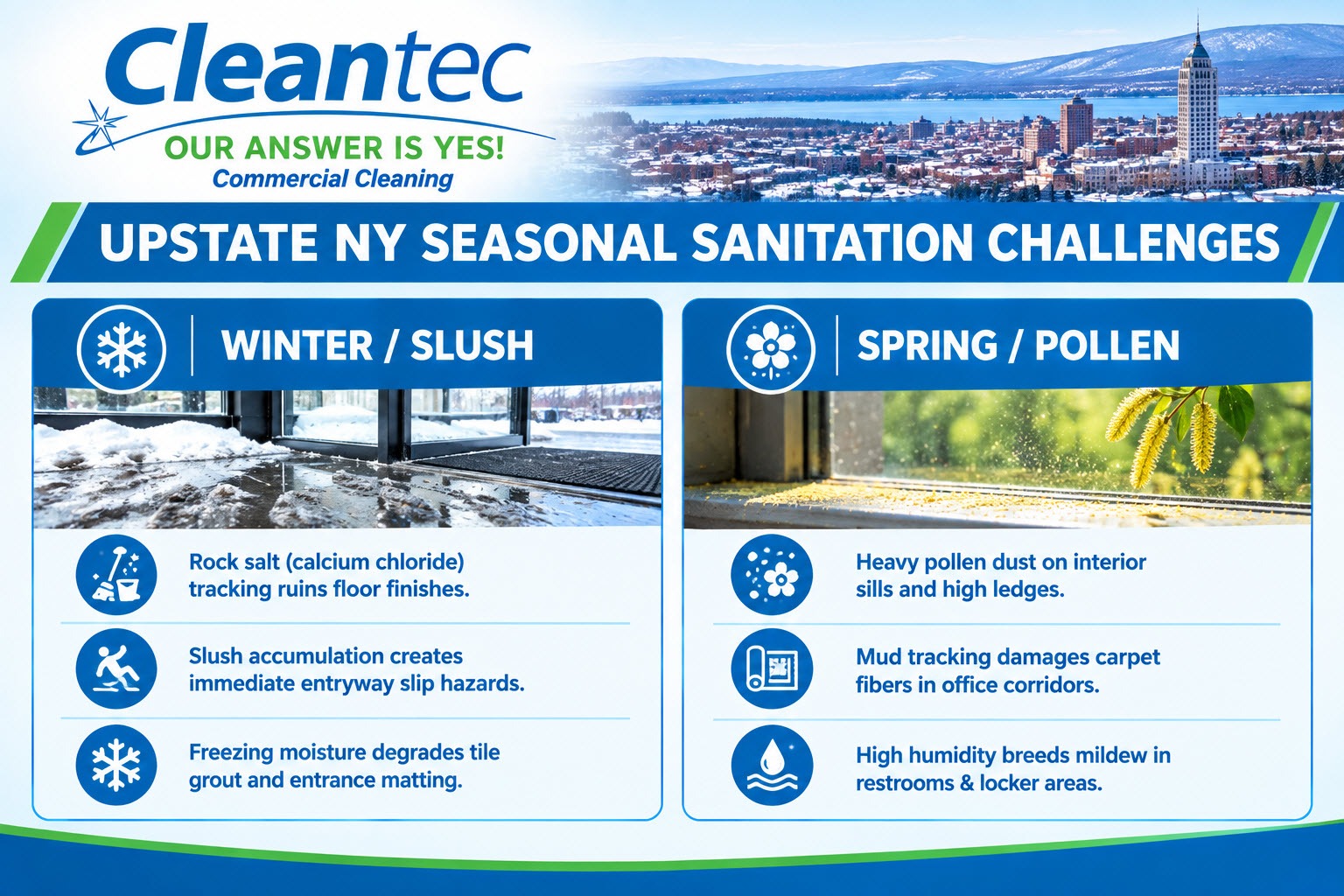
Managing commercial properties across Upstate New York involves severe seasonal weather challenges. Cities like Syracuse, Rochester, Buffalo, Albany, Binghamton, and Ithaca face harsh winters followed by muddy springs.
The Impact of Rock Salt and De-Icers
De-icing compounds tracked into building lobbies create two distinct operational risks:
- Safety Risks: Salt granules mixed with melting snow create a slippery film on tile, terrazzo, and polished concrete, increasing slip-and-fall hazards.
- Floor Damage: Rock salt features an alkaline pH that dissolves protective floor wax, leaving dull white stains and eroding grout lines.
Winter conditions demonstrate the distinct value of daytime cleaning. An evening crew can mop floors at night, but they cannot prevent a visitor from slipping on slush at 10:00 AM. Day porters monitor entrance mats, mop standing water, and clear salt residue continuously during business hours. Overnight crews then run scrubbers to restore floor shine for the next morning.
Financial Analysis: Calculating Operational Value
Choosing between day porters and nighttime cleaning crews requires evaluating labor structures, equipment costs, and liability risks.
Labor Models and Production Rates
Nighttime janitorial cleaning operates on a production-rate model based on square footage. A single evening technician cleans between 2,500 and 4,000 square feet per hour depending on building layout, floor types, and trash density.
Day porter services operate on a dedicated hourly or shift-based staffing model. Because day porters focus on common areas and immediate building needs rather than systematic office coverage, pricing reflects direct labor hours, specialized training, and supervisory support.
Financial Benefits of Day Porter Service
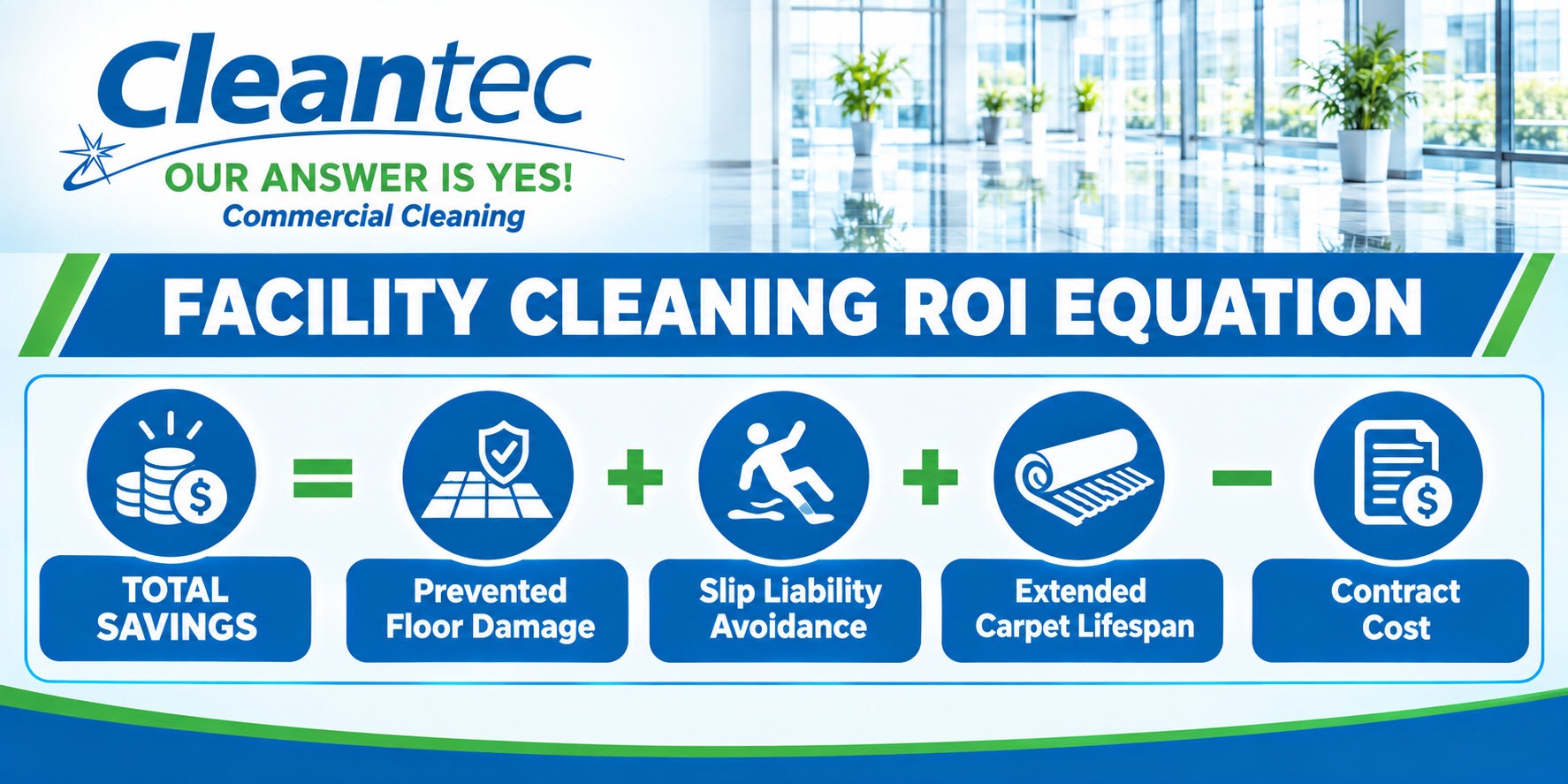
- Slip-and-Fall Risk Reduction: Immediate cleanup of wet entryways reduces liability claims, where average slip settlements create significant financial costs.
- Asset Preservation: Continuous salt removal extends floor finish life, reducing how often you need complete floor stripping and re-waxing.
- Tenant Retention: Clean common areas, stocked restrooms, and neat lobbies directly support tenant renewal rates.
Financial Benefits of Nighttime Cleaning
- Labor Efficiency: Access to empty rooms allows technicians to execute deep cleaning tasks faster, lowering labor costs per square foot.
- Utility Management: Evening crews work under zone lighting, reducing energy use compared to keeping full building lights on all day.
- Equipment Productivity: Industrial scrubbers cover large areas rapidly without needing safety barricades.
Practical Facility Needs Audit Checklist
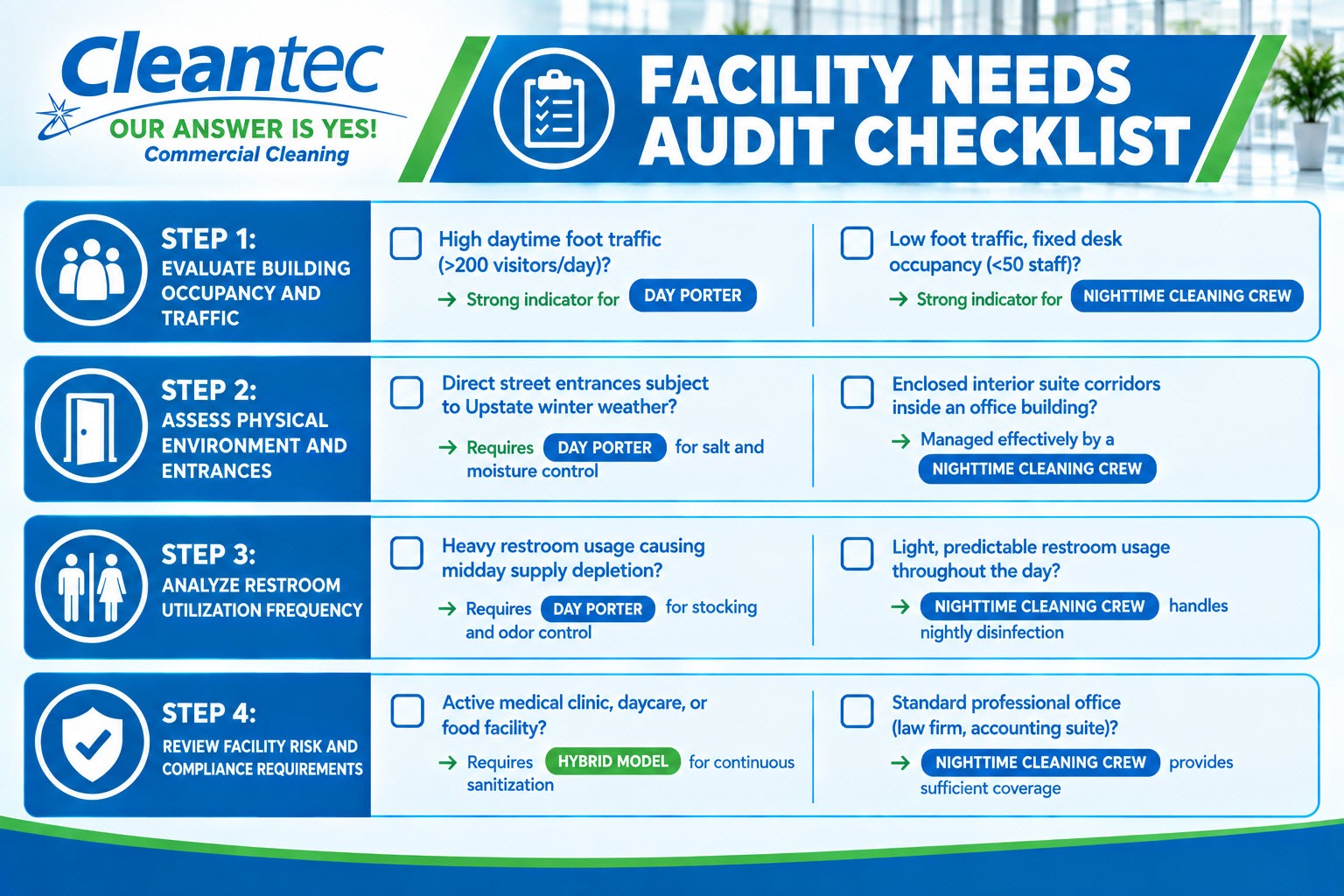
Use this checklist to determine whether your property requires a day porter, a nighttime cleaning crew, or a hybrid model.
Audit Summary
- Majority Day Porter Checks: Your facility requires real-time upkeep to manage foot traffic, weather hazards, and public spaces.
- Majority Night Crew Checks: Your property benefits most from cost-effective overnight building resets and machine floor care.
- Balanced Checks: Deploy a hybrid program combining a daytime porter for common areas with an evening crew for deep sanitation.
Frequently Asked Questions
What is the main operational difference between a day porter and a nighttime cleaning crew?
A day porter works during business hours to keep common areas clean, restock restrooms, and handle immediate spills. A nighttime cleaning crew works after hours to execute deep sanitation, run floor scrubbers, vacuum offices, and reset the building.
Can a day porter replace our nighttime cleaning crew entirely?
No. Day porters focus on continuous common area maintenance rather than deep office cleaning. Heavy equipment noise, wet floors, and systematic trash collection disrupt daytime operations, requiring overnight crews for deep facility resets.
How do day porters help manage winter weather in Upstate New York?
Day porters continuously mop entryways, clear tracked-in slush, neutralize rock salt residue, and set out dry safety mats. This real-time care prevents floor damage and significantly reduces winter slip-and-fall hazards in building lobbies.
Which service model is most cost-effective for smaller office suites?
For properties under 10,000 square feet with light foot traffic, a nighttime cleaning crew is usually most cost-effective. Evening technicians clean empty spaces efficiently without incurring the dedicated hourly labor costs of a full-time day porter.
Partner with Upstate New York’s Commercial Cleaning Experts
Managing commercial real estate requires a janitorial partner that understands operational schedules, labor allocation, and regional weather demands.
Whether your building requires a dedicated day porter to keep lobbies safe from winter slush, an evening crew for deep floor care, or a customized hybrid program, Cleantec delivers reliable service across Syracuse, Albany, Buffalo, Rochester, Ithaca, Binghamton, and Oriskany.
Ready to Optimize Your Facility’s Janitorial Schedule?
Contact Cleantec today to schedule a site walkthrough and receive a clear proposal tailored to your facility footprint, industry standards, and operating budget.
- Phone Direct: 1 (877) 469-0543
- Email: info@cleantec.us
- Request Online Quote: https://www.cleantec.us/request-a-quote/
Older Post
- Technicians Offered IICRC Classes at Cleantec
- Success Starts with a Clean Workplace
- Home Maintenance Tips for Mid-Winter
- How to Remove Tough Carpet Stains
- 7 Tips to Help Sell Your House
- Ensure Your Fire Alarm Works Properly
- Cleaning Tips to Help You Live Green
- Window Cleaning Tips from the Professionals
- Safe Proof Your Home to Prevent Storm Damage
- Cleantec Marks Two-Year Partnership with Cleaning for a Reason